EN


When buyers develop a moisturizer, the first discussion often focuses on familiar ingredients: hyaluronic acid, ceramides, peptides, botanical extracts or barrier-supporting oils. These ingredients matter, but they do not determine the complete product experience. The emulsion structure also influences how the formula spreads, how quickly it appears to absorb, how much residue it leaves and whether it can be filled consistently into the selected packaging.
A qualified moisturizer manufacturer should therefore translate a commercial request—such as “lightweight but nourishing” or “rich without feeling greasy”—into a measurable formulation and manufacturing brief. For procurement teams and skincare brands, understanding this relationship makes sample evaluation more objective and reduces unnecessary reformulation later.
1. What Buyers Are Really Sourcing from a Moisturizer Manufacturer
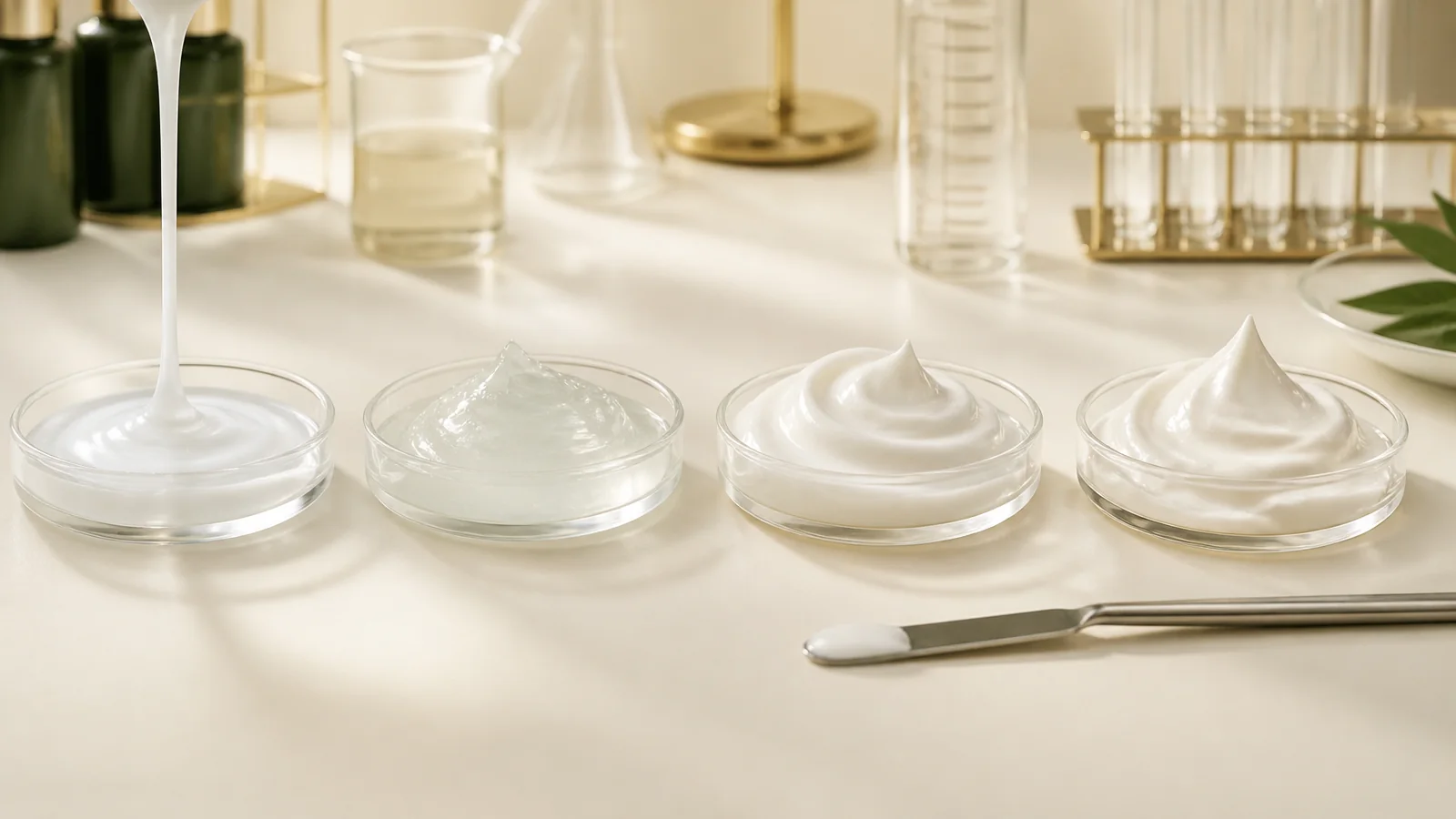
A moisturizer project is not simply a list of active ingredients mixed into a cream base. Buyers are sourcing an integrated product system that must satisfy sensory, stability, packaging, production and commercial requirements.
Behind a simple request for a lotion, gel-cream or rich cream are several technical decisions:
- The balance between water, humectants, emollients and more occlusive materials
- The type of emulsion and emulsification system
- The viscosity and flow behavior required for the selected package
- The intended rub-in time, finish and residual skin feel
- The compatibility of active ingredients with the base formula
- The preservation approach and expected product-use conditions
- The ability to reproduce the approved texture during bulk manufacturing
| Buyer Request | What Must Be Defined Technically | Why It Matters |
|---|---|---|
| “Lightweight and fast absorbing” | Oil-phase level, emollient selection, viscosity, rub-in time and residual film | Two light-looking lotions can leave very different levels of tack or residue. |
| “Rich but not greasy” | Emulsion structure, oil profile, rheology and dry-down behavior | Richness should provide cushion without creating an unwanted oily finish. |
| “Suitable under makeup” | Film behavior, pilling risk, tack and compatibility with layered products | A moisturizer may feel pleasant alone but perform differently beneath sunscreen or makeup. |
| “Premium texture” | Pick-up, break, glide, cushion, after-feel and packaging experience | Premium positioning must be reflected in the complete application experience. |
Buyers comparing lotion, gel-cream and rich cream directions can explore our private label face cream collection to review product formats before preparing a customized development brief.
2. How Emulsion Systems Shape Moisturizer Texture
Most moisturizers combine water-based and oil-based materials within a controlled emulsion. However, the arrangement of these phases and the supporting formulation system can create very different sensory results.
| System Direction | Typical Sensory Direction | Common Product Positioning | Buyer Considerations |
|---|---|---|---|
| Oil-in-water emulsion | Fresh, spreadable and relatively easy to rinse from the hands | Daily lotions, facial moisturizers and lightweight creams | Can range from fluid lotion to substantial cream depending on the full formulation. |
| Water-in-oil emulsion | Richer, more protective and more persistent on the skin | Dry-skin, cold-climate or protective-care concepts | Requires careful sensory design to avoid excessive heaviness for the intended customer. |
| Gel-cream system | Fresh, water-light, cooling and quick-breaking | Oily-skin, humid-climate and modern lightweight positioning | “Gel-cream” describes a sensory direction rather than one universal technical formula. |
| Lamellar-style emulsion | Cushioned, refined and often associated with barrier-care positioning | Premium moisturizers and skin-comfort concepts | The complete formula and supporting evidence must align with any product claims. |
These categories are useful starting points, but they should not be treated as fixed sensory guarantees. The final result also depends on the oil-phase materials, emulsifier selection, polymers, fatty alcohols, powders, humectants, fragrance and processing method.

3. “Fast Absorption” Is a Sensory Target, Not a Complete Formula Brief
Buyers frequently request a fast-absorbing moisturizer. However, “absorption” in a cosmetic briefing usually refers to the user’s perception of how quickly the formula spreads and loses its wet, oily or sticky feel. It should not be used as an undefined promise about deep skin penetration.
To make this request useful, break it into observable criteria:
- Initial spread: Does the moisturizer distribute easily or drag across the skin?
- Rub-in time: How long does it take before the formula no longer feels wet?
- Tack: Is there noticeable stickiness after approximately 30 seconds?
- Residual oiliness: Does a greasy film remain after one to three minutes?
- Cushion: Does the product still feel protective and comfortable?
- Finish: Is the final result matte, natural, dewy or glossy?
- Layering: Does it pill or roll when used with sunscreen or makeup?
4. Why the Same Active Ingredients Can Produce Very Different Moisturizers
Two products may both feature hyaluronic acid, ceramides, niacinamide or botanical extracts, yet feel completely different during application. This is because the featured actives represent only part of the formula.
A hyaluronic acid moisturizer, for example, could be developed as a fresh gel-cream, a silky lotion, a dense barrier cream or a rich overnight product. Each version may use a different emulsion structure, oil profile, thickening system and packaging format.
This is why copying an ingredient list does not automatically reproduce a benchmark product’s texture. Procurement teams should provide both an ingredient direction and a sensory benchmark. Reference products, texture descriptions, target climate and intended routine position can help the development team understand the desired experience more accurately.
5. Scale-Up Risks in Commercial Moisturizer Manufacturing
An approved laboratory sample is an important milestone, but commercial manufacturing introduces additional variables. Increasing batch size changes how materials are heated, mixed, homogenized, cooled, deaerated, held and transferred.
The production team must control the process parameters that influence the final appearance and sensory profile. Depending on the formulation, these may include:
- Water-phase and oil-phase preparation temperatures
- Material addition order and addition speed
- Mixing and homogenization conditions
- Cooling rate and the timing of temperature-sensitive additions
- Vacuum deaeration and control of trapped air
- Bulk holding conditions before filling
- Transfer and filling conditions for the selected package
| Observed Issue | Possible Development Area to Review | Commercial Impact |
|---|---|---|
| Bulk product is thinner than the approved sample | Process conditions, cooling profile, material variation or batch-scale mixing | May affect appearance, dispensing and customer perception. |
| Texture feels waxy or drags during application | Oil-phase structure, rheology and sensory balance | May conflict with lightweight or premium-positioning requirements. |
| Product pills during layered use | Film-forming materials, polymers, application amount and compatibility with layered products | Can create complaints even if the product performs well when used alone. |
| Visible air remains in the cream | Mixing, deaeration, transfer and filling conditions | May affect visual quality and filling presentation. |
| Pump output is inconsistent | Formula viscosity, flow behavior and dispensing-component suitability | May create under-dispensing, product waste or user frustration. |
A reliable scale-up process does not mean that every production question can be solved by one standard setting. It means that the manufacturer understands which parameters are critical for the formula and establishes appropriate production and quality-control procedures.
Turn Your Texture Brief into a Manufacturable Formula
Tell us whether you are developing a lotion, gel-cream, daily moisturizer or rich facial cream. Share your target market, sensory benchmark, packaging direction and expected order quantity so our team can evaluate the project more effectively.
Discuss Your Moisturizer Project6. Packaging Must Be Selected with the Emulsion
Packaging should not be finalized only on visual preference. A moisturizer’s viscosity, flow, air sensitivity, dose requirement and intended usage experience affect whether it is better suited to a jar, tube, pump bottle or airless system.
| Packaging Format | Potential Advantages | Questions to Confirm |
|---|---|---|
| Jar | Familiar cream presentation and premium visual options | Is repeated hand contact acceptable for the product concept? Is the texture easy to pick up? |
| Tube | Portable, practical and suitable for many lotion-to-cream textures | Can the product dispense cleanly? Is the opening suitable for the viscosity? |
| Lotion pump | Convenient dosing for fluid and medium-viscosity products | Does the pump provide consistent output throughout use? |
| Airless package | Controlled dispensing and reduced direct product exposure during use | Is the formula suitable for the mechanism, and can it prime and dispense consistently? |
A practical development sequence is to define the texture target, prepare the preliminary formula, review its flow and viscosity, shortlist packaging, and then evaluate the complete formula–package system before bulk production.
For a broader comparison of jars, tubes, pumps, airless bottles and decoration options, read our private label cosmetic packaging guide.
7. How Buyers Should Evaluate Moisturizer Samples
Experienced procurement teams should evaluate a sample in stages rather than making a decision immediately after opening the container. A structured scorecard creates clearer feedback and makes revisions easier to communicate.
Review appearance, odor, pump output, stringiness, air bubbles and whether the texture matches the intended package.
Assess pick-up, initial spread, glide, freshness, richness and any whitening or soaping during rub-in.
Check tack, drag, oiliness, film formation and whether the moisturizer is beginning to settle comfortably.
Review the final finish, softness, cushion, residue and overall perception of absorption.
Determine whether the skin feels dry, comfortable, coated, sticky or appropriately moisturized.
Test the product with the intended routine, including serum, sunscreen or makeup, and observe pilling or interaction.
A simple one-to-five rating system can be used for spreadability, richness, tack, greasiness, cushion, finish, fragrance and dispensing. Procurement teams should also record the application amount and testing conditions so that different samples are compared consistently.
8. How to Prepare a Better Moisturizer Development Brief
The clearer the brief, the more efficiently a development team can recommend an appropriate starting formula. Your brief does not need to contain every technical answer, but it should explain the commercial and sensory direction.
Moisturizer Development Brief Checklist
- Product format: lotion, gel-cream, daily cream, night cream or intensive moisturizer
- Target customer: skin type, age group, routine and main usage scenario
- Target market: destination country, climate and sales channel
- Sensory direction: spread, richness, tack, finish, fragrance and absorption perception
- Formula direction: preferred actives, ingredients to avoid and claim direction
- Benchmark: reference products or textures the brand wants to approach
- Packaging: jar, tube, pump or airless preference and target capacity
- Commercial plan: expected first order, target price and launch schedule
You can also review our product development and formulation insights for related guidance on private label skincare projects.
9. Questions to Ask a Moisturizer Manufacturer Before Ordering Samples
- Which moisturizer formats does the factory regularly develop and manufacture?
- How will the development team translate our sensory terms into measurable sample targets?
- Can we provide benchmark products for texture evaluation?
- How are viscosity, appearance, color and odor reviewed during development and production?
- How is a laboratory formula prepared for commercial scale-up?
- When should the final packaging be selected?
- How will formula viscosity and pump or tube dispensing be evaluated together?
- What sample approval information should the buyer provide before bulk production?
- What project information is needed to estimate price and lead time?
- Which documents and product evaluations can be discussed for the intended target market?
For customized private label moisturizer projects, our standard starting MOQ is 5,000 units per SKU. Final MOQ may vary depending on formula complexity, packaging format, fill volume, decoration requirements and the availability of selected components.
Choosing the Right Development Partner
The most useful moisturizer manufacturer is not simply the supplier with the longest ingredient list or the thickest sample. The right partner should understand how formulation structure, manufacturing conditions and packaging work together to create a product that can be approved, filled and reproduced consistently.
For buyers, the key is to communicate the intended experience in practical terms. Define how the moisturizer should spread, how quickly tack should decrease, what finish it should leave, how it should perform in a routine and which packaging format supports the intended positioning.
By aligning these points before sampling, brands can evaluate proposals more objectively and move toward bulk production with fewer avoidable revisions.
Frequently Asked Questions
What information should I send before requesting a moisturizer sample?
Send the intended product format, target customer, destination market, texture and finish preferences, key ingredient direction, benchmark products, packaging preference, expected quantity and target launch schedule. Even if some details are not final, this information helps the manufacturer recommend a more relevant starting point.
What is the difference between a lotion, gel-cream and face cream?
A lotion is generally more fluid, while a gel-cream is usually designed for a fresh, water-light sensory profile. A face cream often provides more body, cushion or richness. However, these terms are not universal technical specifications, so buyers should define the intended viscosity, spread and after-feel rather than relying only on the product name.
Why can a moisturizer sample change during scale-up?
Larger batches involve different heating, mixing, homogenization, cooling, transfer and filling conditions. These variables can influence viscosity, appearance and sensory performance. A controlled scale-up process is used to identify critical parameters and support consistency between the approved direction and commercial production.
Should packaging be selected before or after moisturizer sampling?
Packaging direction should be discussed early, but final approval should consider the actual formula. The product’s viscosity, flow, dosage, protection requirements and dispensing behavior must be compatible with the selected jar, tube, pump or airless system.
Can one moisturizer formula be adjusted for different climates or target markets?
The product direction can be adjusted according to the intended climate, customer preference and market positioning. For example, a brand may request a lighter finish for hot and humid conditions or a richer, more protective sensory profile for dry or cold environments. Any revised formula should be evaluated as its own product direction.
Request a Custom Moisturizer Development Proposal
Share your target texture, hero ingredients, benchmark product, packaging preference, target market and expected order quantity. INTE can help you evaluate a practical formula and production direction for your private label moisturizer project.
Contact INTE About Your Formula Hot News