 EN


How to audit a skincare factory without visiting China?
For a cross-border buyer, a remote skincare factory audit is not a shorter version of due diligence. It is a structured way to turn a supplier’s claims into evidence you can review, question, and compare for a skincare sourcing decision. A well-run virtual audit cannot show every condition that an on-site visit might reveal, but it can help a skincare brand decide whether a manufacturer deserves the next stage of review.
The useful question is not “Can this skincare supplier send a polished presentation?” It is “Can the supplier connect its documents, people, rooms, equipment, and batch records in a consistent evidence trail?” That distinction matters when you are evaluating a skincare project involving formulation, packaging, labeling, stability work, or market-specific documentation.
Start with the audit scope, not the video call
Before scheduling a walkthrough, write a one-page skincare audit brief. Define the product category, destination market, planned claims, packaging format, expected order stage, and the decisions your team must make after the audit. A facial serum in single-use packaging, for example, raises different questions from a jarred cream or a rinse-off cleanser. The brief prevents a remote skincare review from becoming a general company tour with no decision value.
Assign an owner from procurement or quality, and invite the people who will use the answers: brand, regulatory, product development, and packaging teams. Ask the supplier to nominate a host who can move between production, quality, warehouse, and documentation colleagues during the session. When questions need to be relayed through several people, gaps in the skincare evidence trail are easier to miss.
- List the specific skincare products or development routes in scope.
- State the destination market and identify skincare items that require later regulatory confirmation.
- Set an evidence request list and a secure method for sharing sensitive files.
- Decide which observations require a follow-up sample, third-party review, or future site visit.
Use a recognized GMP framework as a question map
ISO 22716:2007 provides cosmetic GMP guidance covering production, control, storage, and shipment. It is useful as a map for a skincare audit because it moves the skincare supplier discussion beyond a factory’s appearance. It is not, by itself, evidence that a particular skincare factory meets every buyer, market, or project requirement. Treat it as a way to organize questions and identify documents to examine.
Build your remote skincare checklist around personnel, premises, equipment, raw materials, production, quality control, storage, complaints, and records. This keeps skincare audit questions connected to the actual proposed product route. For each topic, request one current document, one live demonstration, and one traceable example where appropriate. A procedure alone shows an intended process. A live explanation plus a recent record gives you more context about how that process is used.
Request documents before the live walkthrough
Document review is often where a skincare audit gains depth. Ask for a controlled skincare document index first, rather than an unstructured folder of certificates and slides. Then select a small number of records that match the product route you are considering. The goal is not to collect every file; it is to test whether versions, approvals, and day-to-day records tell the same story.
Documents worth sampling
- Organization chart and responsibilities for quality, production, and release decisions.
- Training records for personnel involved in the relevant skincare process.
- Cleaning, maintenance, calibration, and change-control procedures with recent examples.
- Raw-material receipt, status labeling, and supplier-approval records.
- A redacted skincare batch manufacturing record, in-process checks, finished-product release record, and retained-sample procedure.
- Deviation, complaint, corrective-action, and recall-handling procedures where these are relevant to the proposed skincare range.
FDA cosmetic GMP guidance, for example, points to clean and appropriately sanitized cosmetic-contact equipment and to batch-control records that cover processing, handling, filling, sampling, adjustments, and code marks. Use such examples to improve your questions, not to make an unverified compliance conclusion. Requirements should be checked against the destination market and the product’s intended claims.
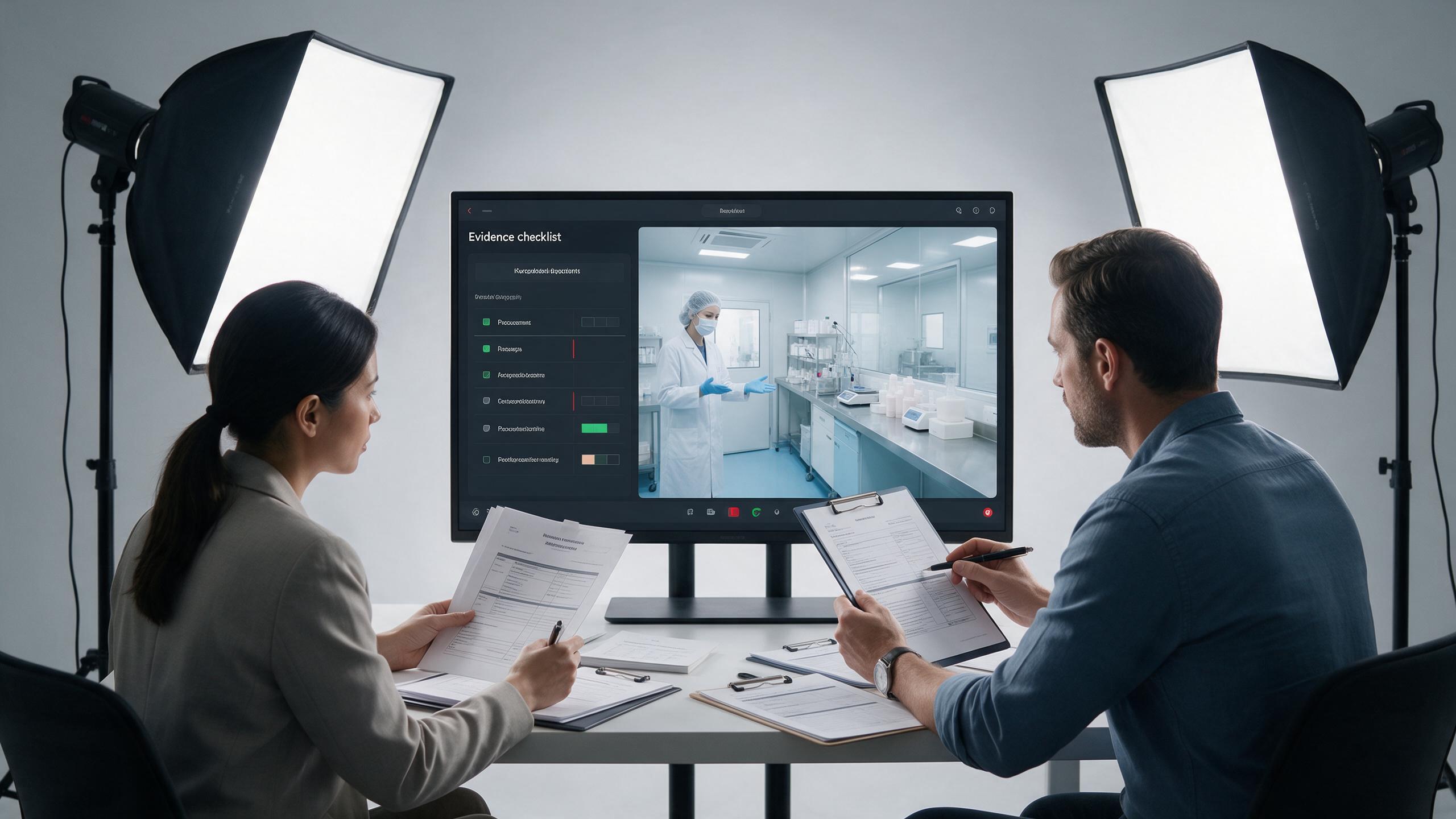
Plan a live video route that tests the documents
A remote skincare factory walkthrough works better when the route is agreed beforehand but not reduced to a fixed promotional script. Ask for a continuous, live view where practical, with the host showing date or time context and moving from one relevant skincare area to the next. Screen sharing is useful for records; a live mobile view is useful for linking a record to the physical environment.
For a skincare line, the route may include receiving, quarantine or status-controlled materials, weighing, mixing, holding, filling, packaging, quality-control areas, finished-goods storage, and sample retention. Do not ask the host to disclose another customer’s confidential information. Instead, request anonymized or redacted skincare examples and observe the controls around identification, segregation, cleanliness, and record access.
Pause at points where the skincare documents make a promise. If a cleaning log identifies a vessel, ask to see how equipment is identified. If a batch record lists a check, ask who performs it and how an exception is recorded. If inventory is status-labeled, ask how a person can distinguish released, quarantined, and rejected materials. The aim is consistency, not a dramatic “gotcha” moment.

Interview the people behind the system
Remote skincare audits are stronger when the buyer hears from more than a sales contact. Short interviews with production, quality, warehouse, and technical representatives can reveal whether roles and handoffs are understood. Ask open questions first, then compare skincare-process answers with the documents. A good response may include a limitation or a request to verify a detail; confidence without supporting records is less useful than a clear follow-up path.
Useful questions include: Who can stop a skincare batch? How is a change in a raw material or packaging component assessed? Who reviews a deviation? How are skincare customer specifications controlled? What happens if an in-process result does not meet the planned range? The answers should help your team identify information that needs more proof, rather than force a premature yes-or-no decision.
Create an evidence log and close with actions
During the skincare audit, record every observation in an evidence log with the topic, file or screen shown, responsible person, date, question, answer, and follow-up owner. Separate three labels: confirmed by evidence, plausible but awaiting evidence, and outside the scope of the remote review. This small discipline stops a later skincare commercial discussion from turning assumptions into facts.
End with a closing meeting. Summarize strengths, open items, and the next verification method for each item. Some findings may be resolved through a newer record, a sample review, or a focused follow-up call. Higher-risk questions—such as conditions that cannot be observed reliably by video—may justify an independent audit or an on-site visit before a skincare program proceeds.
Know what a remote skincare audit cannot prove
A virtual review can establish useful visibility, but camera angle, scheduling, file selection, and connectivity shape what you see. It should not be treated as proof of every operating condition, product outcome, or market compliance status. For skincare products, the final skincare supplier decision also depends on the formula, claims, packaging interaction, applicable records, and the requirements of the destination market.
For that reason, use the remote skincare audit as a staged decision tool: verify basic systems, identify evidence gaps, request targeted follow-up, and choose the next level of skincare supplier review based on product and market risk. This approach gives a brand team a clearer basis for supplier discussions while keeping quality, documentation, and regulatory questions visible from the start.
 Hot News


